Buying at auction as a first home buyer: how finance and pre-approval fit in
5 November 2026 5 min read
A winning bid at a New Zealand auction is usually an unconditional agreement to buy the home. Finance, the deposit and the checks on the property need to be sorted before auction day, because there's no finance condition to come back to once the hammer falls. Pre-approval is a useful start, and it isn't the same thing as the lender saying yes to that particular home.
Your next step
If you would like to line up finance before an auction, we can connect you with someone who can talk through your options, with no obligation.
It takes about 90 seconds, then we put you in touch with someone who can talk through your options, and there's no credit check to enquire.
Key points
- Auctions are unconditional. If your bid wins, you're committed to buy.
- Pre-approval looks at you. The lender may still need to approve the specific property, for example after a valuation.
- The deposit is usually due on auction day. It's commonly around 10% of the price, and the auction terms set the exact amount.
- KiwiSaver usually isn't paid out in time for that same-day deposit. An approved withdrawal goes to your lawyer, and processing takes time.
- The property checks happen before you bid, including a title search, council information, a building report and a conversation with your lawyer.
What does an unconditional auction mean for finance?
Settled.govt.nz, the official guide for people buying and selling homes, says auctions are unconditional. If your bid wins, you're committed to the purchase, and you'll usually pay the deposit on the day, straight after the auction. A private offer can still carry a finance condition and a date to work towards. An auction generally doesn't, unless the seller has already agreed a change in writing before anyone bids.
That's why the checklist for the week you go unconditional is something to read early, rather than on auction day. The checks that would have been conditions on a private offer move to before you bid.
What is pre-approval, and where does it stop?
Pre-approval is a lender's early view of what it may lend you, based on your income, debts and deposit, before a specific home is chosen. Getting pre-approval takes about 5 to 10 working days as a guide. Once you have it, it's usually valid for 90 days, but it pays to check with your lender. The home loan pre-approval page walks through that timing.
Even with pre-approval in hand, Settled.govt.nz says your lender may still want specific details about the property before you attend the auction. Confirming the loan is a separate step. The lender may ask for a valuation, and it may ask for a LIM. A building report is one of the checks buyers arrange beforehand, because an unconditional bid doesn't leave a later date for it. Pre-approval on its own doesn't mean the lender has approved the house you want to bid on.
Settled.govt.nz also says your lender will need proof of property insurance before settlement day, and an auction doesn't leave a condition to sort that out later, so it's worth asking your lender what it needs before you bid.
When is the auction deposit due?
If you win, Settled.govt.nz says you'll usually be asked to sign the sale and purchase agreement and pay the purchase deposit as soon as the auction is over, including if you're bidding by phone or online. The auction terms set the amount and the exact timing. Settled.govt.nz's auction quiz says deposits are usually around 10% of the price reached at the auction. That figure is a common guide, not a rule that applies to every sale, so read the terms for the auction you're going to.
The money you pay the agent on the day isn't always the same figure a lender counts towards the loan. What matters that afternoon is money you can transfer then, which is usually savings you already hold, and sometimes a gift that's already in your account. The deposit page explains what a first home deposit is for in the wider purchase.
Can KiwiSaver cover the auction deposit?
Sorted says KiwiSaver can make up all or part of a first home deposit. At an auction, though, it's usually not paid out in time for the deposit due on the day, unless the timing has been planned with your provider and your lawyer, and the seller has agreed any change before the auction.
Inland Revenue says you need to have been in KiwiSaver for at least 3 years before a first-home withdrawal, and at least $1,000 has to stay in the account. You apply to your own provider. Kāinga Ora says that if the withdrawal is approved, the money is paid to your solicitor on or before settlement day, and first home buyers apply through their provider rather than through Kāinga Ora. Sorted says providers typically need about 10 working days to process a withdrawal, sometimes longer, and they need a signed sale and purchase agreement plus a solicitor's letter of undertaking before they pay it.
You only have that signed agreement once you've won, and the deposit is usually due the same day, so the processing time hasn't started yet. The KiwiSaver money isn't sitting in your account ready to transfer to the agent. It can still form part of the price at settlement, which is a later date written into the agreement, as long as your provider and your lawyer are lined up for that date. If you want the deposit paid later, or in two parts, Settled.govt.nz says any change has to be agreed with the seller before the auction. The seller doesn't have to accept it. The KiwiSaver first-home withdrawal page covers the usual steps, and your provider's own rules are the ones that apply to you.
What should I sort out before auction day?
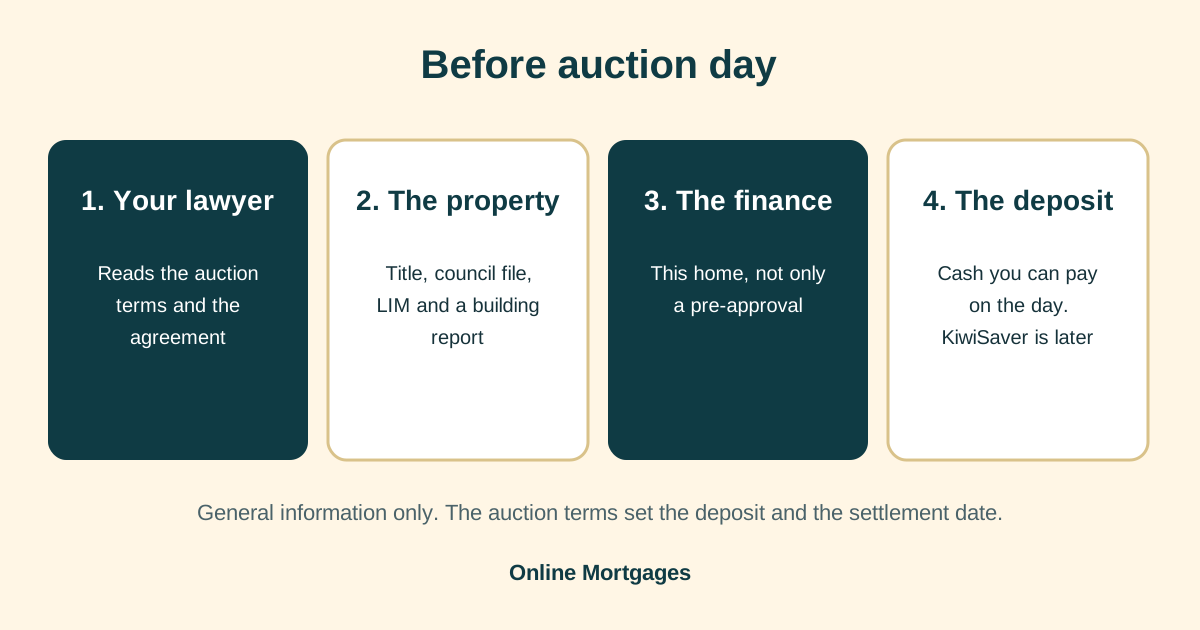
Settled.govt.nz suggests learning as much as you can about the property before the auction, and asking your lawyer to review the information you're given. A practical order for most first home buyers looks like this.
- Register your interest with the agent, so you receive the auction terms, the sale and purchase agreement, and any notice of a pre-auction offer.
- Ask your lawyer to read those documents, including the deposit amount, when it's due, and the settlement date.
- Do the property checks while there's still time: a title search, council information such as a LIM, and a building report.
- Talk with your lender about this specific home, including any valuation they want, before you decide a limit for bidding.
- Separate the money you can pay on the day from money that arrives later, such as KiwiSaver.
If bidding doesn't reach the seller's reserve, the property can be passed in, which means it hasn't sold. The highest bidder may be able to negotiate afterwards, and the auction rules may still apply for a while, so a later offer can still need to be unconditional. Your lawyer can explain what that means for the sale in front of you. This page doesn't suggest that you bid, and it doesn't suggest that you add or drop a condition.
Before bidding starts, the auctioneer will say whether the seller may bid. Settled.govt.nz says a vendor bid is only allowed while the reserve hasn't been reached, and the auctioneer must make it clear when a bid is a vendor bid.
Buying at auction FAQs
Is a winning bid at a New Zealand auction unconditional?
Usually, yes. Settled.govt.nz says auction bids are unconditional offers to purchase, so if you win you're committed to buying. Any change, or any extra condition, has to be agreed with the seller before the auction.
Does pre-approval mean the lender has approved the home I want to bid on?
No. Pre-approval is an early view of what a lender may lend you, based on your own documents. The lender may still want details of that property, such as a valuation or a LIM, and it may still decide the home doesn't fit its rules.
Can KiwiSaver be used for the deposit on auction day?
Usually the money isn't available the same day. An approved first-home withdrawal is paid to your lawyer, and your provider needs time plus a signed agreement before it pays. Check your provider's rules, and ask your lawyer what you can pay on the day.
What happens if bidding doesn't reach the reserve?
Settled.govt.nz says the property can be passed in, which means it hasn't sold. The highest bidder may be able to negotiate afterwards, and the auction rules may still apply for a while, so a later offer can still need to be unconditional.
General information only, not advice. We're a referral service and may receive a commission.
Sources (checked 5 November 2026):
- Settled.govt.nz: Buying by auction
- Settled.govt.nz: Auction quiz
- Settled.govt.nz: Confirming your finances
- Inland Revenue: Getting my KiwiSaver savings for my first home
- Kāinga Ora: KiwiSaver first-home withdrawal
- Sorted: How KiwiSaver can help you get into your first home
Reviewed against Settled.govt.nz, Inland Revenue, Kāinga Ora and Sorted.
Related reading